Showing posts with label Air Emissions. Show all posts

Wednesday, December 9, 2020

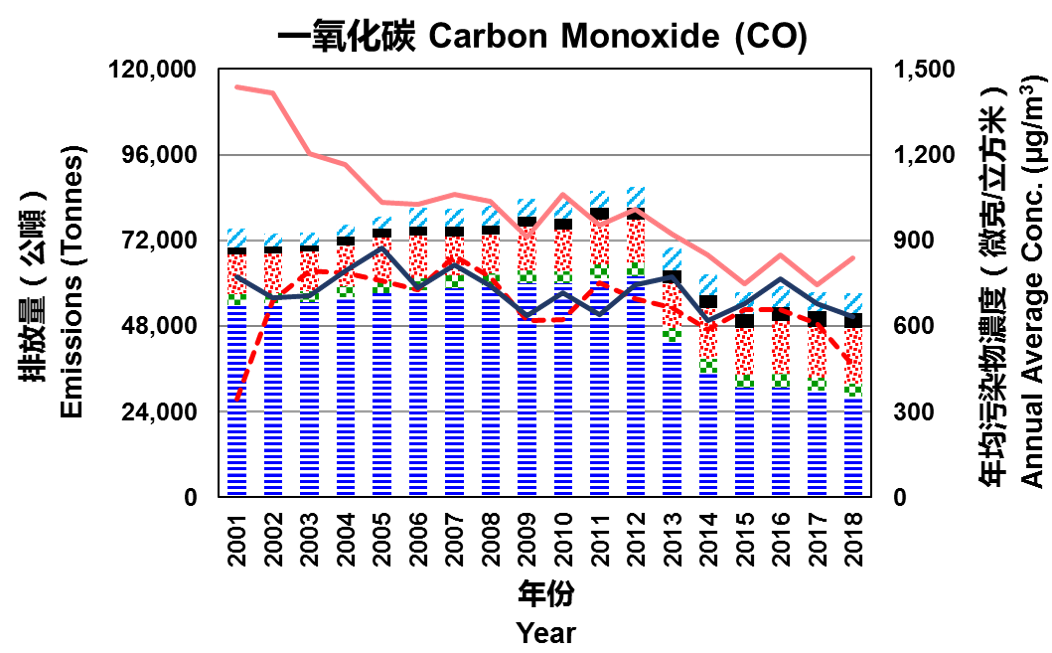
Hong Kong Air Pollutant Emission Inventory - Carbon Monoxide

  Chart for 2001-2018 Carbon Monoxide (CO) Emissions

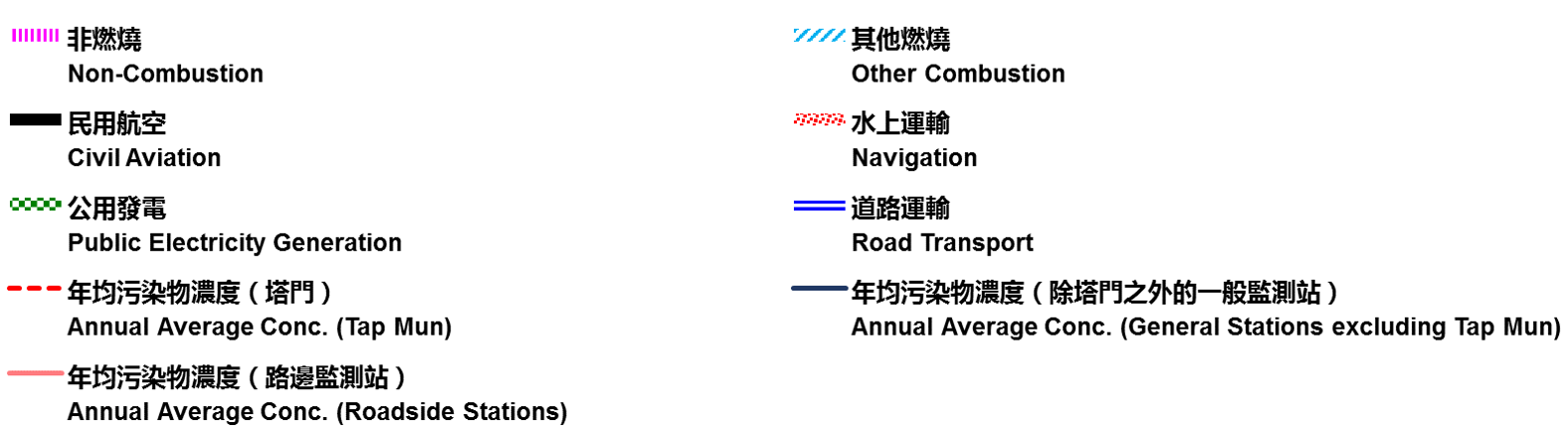
Legend for Carbon Monoxide (CO) Emissions Chart

See Data

Relative Significance

Between 2001 and 2018, CO emissions decreased by 24% which were mainly caused by the decline in emissions from the road transport sector.  Road transport and navigation sectors were two major sources of CO emissions, accounting for 50% and 27% of the total CO emissions in 2018, respectively. 

During the same period, the gap between the CO concentration levels measured at the EPD's roadside and ambient air quality monitoring stations have narrowed, indicating that vehicular CO emissions have been reduced.


Source: https://www.epd.gov.hk/epd/english/environmentinhk/air/data/emission_inve_co_C.html

Wednesday, October 9, 2019

Reductions of China national emission improved air quality in past 3 years

The reductions are important in helping to control China’s national emissions which could lead to an improvement in air quality and considerable health benefits.

A team of experts from the UK and China analysed emissions from coal, oil, natural gas and biomass power plants, with a focus on coal-fired power plants as the major contributors to ambient air pollution.

The study, published today in Nature Energy, analysed data from 2014, when China introduced the ambitious Ultra-Low Emissions (ULE) Standards Policy for renovating coal-fired power stations to limit air pollutant emissions, to 2017.

The team found that between 2014 and 2017, China’s annual power plant emissions of sulphur dioxide, nitrogen oxide and particulate matter dropped by 65%, 60% and 72% each year respectively from 2.21, 3.11 and 0.52 million tonnes in 2014 to 0.77, 1.26 and 0.14 million tonnes in 2017, under the ULE standards policy.


Source: https://www.ucl.ac.uk/news/2019/oct/china-track-meet-its-ultra-low-emissions-goals-2020

Polluting emissions from Chinese thermal power plants declined significantly between 2014 and 2017, according to research involving UCL.

China is on track to meet its ultra-low emissions goals for 2020

Wednesday, June 26, 2019

European Airports to cut carbon emissions to zero by 2050


European airports want to cut carbon emissions to zero by 2050 at the latest, Airports Council International (ACI)-Europe said June 26 as its members gathered in Limassol, Cyprus for its annual congress and general assembly.

ACI Europe said 194 airports run by 40 airport operators across 24 European countries had also individually committed to the same objective, marking “a step change in the climate action of the airport industry.”

It estimated that, based on current European airport traffic volumes—2.34 billion passengers in 2018—the commitment would eliminate 3.46 million tons of annual CO2 emissions as of 2050.

Continue Reading

Thursday, May 16, 2019

SDG 12 responsible consumption and production - Air Emission - Sulphur Oxides (SOx), nitrogen oxides (NOx), particulate matter (PM) and carbon dioxide (CO2)

Sulphur Oxides (SOx), nitrogen oxides (NOx), particulate matter (PM) and carbon dioxide (CO2) are emitted to the atmosphere. Collectively, ship generated emissions can be significant in areas subject to heavy marine traffic leading to concerns regarding air quality, bot at local level, in coastal areas, or in a more global level, regarding to CO2 emissions leading to Greenhouse Gas emissions and contributing to global warming. Tracking and Monitoring by Environmental Management System EMS is necessary for SME.

With Air Management Module, Material Monitoring Module, Waste Monitoring Module, amount of emission with ghg scope summary reporting will be generated with friendly chart system automatically.

Features of Environmental Management System - Environmental Features - SDG Goal 1-17 can be achieved 

p.s. PROGRESS OF GOAL 12 IN 2018
Decoupling economic growth from resource use is one of the most critical and complex challenges facing humanity today. Doing so effectively will require policies that create a conducive environment for such change, social and physical infrastructure and markets, and a profound transformation of business practices along global value chains.

The per capita “material footprint” of developing countries grew from 5 metric tons in 2000 to 9 metric tons in 2017, representing a significant improvement in the material standard of living. Most of the increase is attributed to a rise in the use of non-metallic minerals, pointing to growth in the areas of infrastructure and construction.
For all types of materials, developed countries have at least double the per capita footprint of developing countries. In particular, the material footprint for fossil fuels is more than four times higher for developed than developing countries.
By 2018, a total of 108 countries had national policies and initiatives relevant to sustainable consumption and production.
According to a recent report from KPMG, 93 per cent of the world’s 250 largest companies (in terms of revenue) are now reporting on sustainability, as are three quarters of the top 100 companies in 49 countries.
Source: Report of the Secretary-General, The Sustainable Development Goals Report 2018

Wednesday, August 9, 2017

Air Emissions

As a result from different onboard combustion and energy transformation processes, remarkably for propulsion and energy production, ships represent sources of different substances to the atmosphere. Sulphur Oxides (SOx), nitrogen oxides (NOx), particulate matter (PM) and carbon dioxide (CO2) are emitted to the atmosphere as a direct result. Collectively, ship generated emissions can be significant in areas subject to heavy marine traffic leading to concerns regarding air quality, bot at local level, in coastal areas, or in a more global level, regarding to CO2 emissions leading to Greenhouse Gas emissions and contributing to global warming. Many actions have however been undertaken in recent years to significantly reduce air emissions from ships. Most of these actions have been taken through Annex VI of MARPOL, an international instrument developed through the International Maritime Organization (IMO) that establishes legally-binding international standards to regulate specific emissions and discharges generated by ships.

Source: http://www.emsa.europa.eu/main/air-pollution.html